🔍 The Secret Recipe Behind Your Digital World: What is an Algorithm?
5 min read
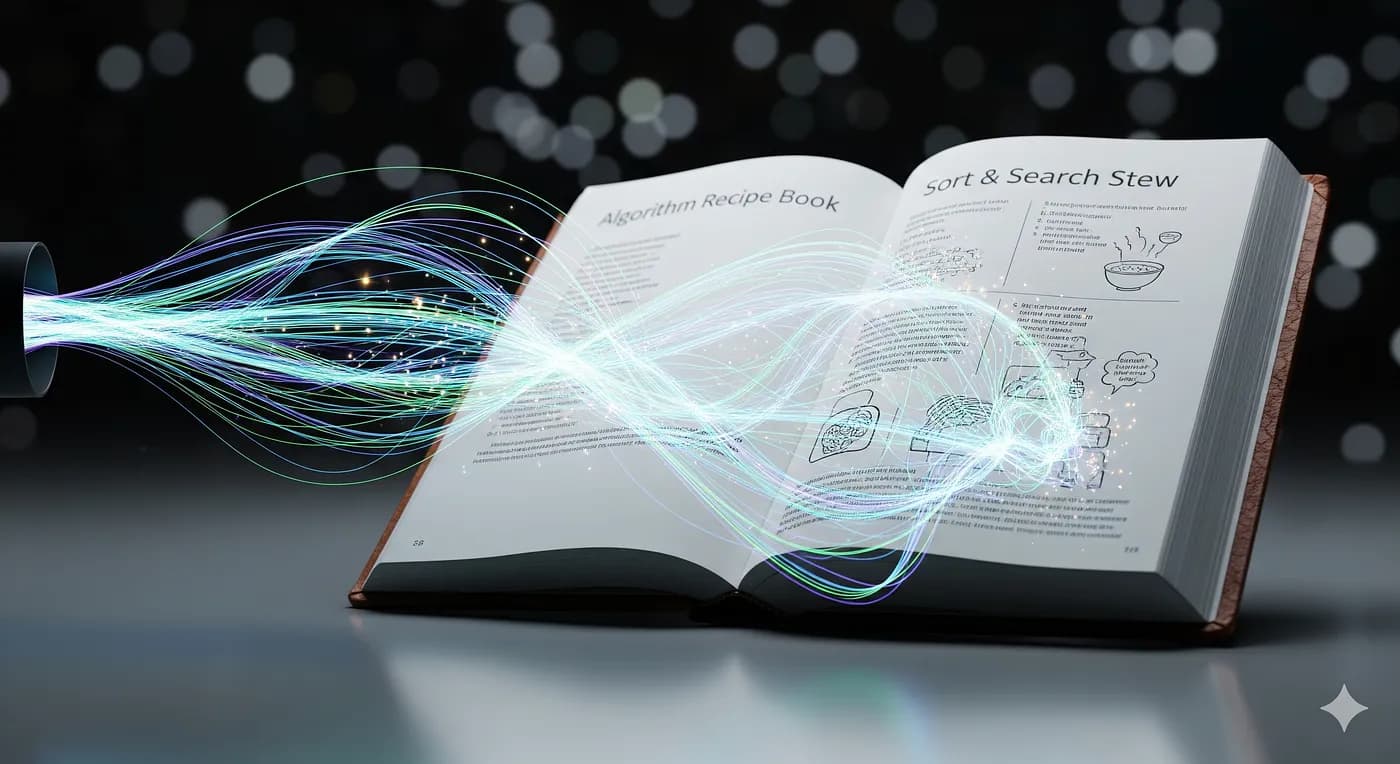

Have you ever baked a cake? You start with ingredients like flour and sugar, follow a series of steps in a recipe, and end up with a delicious dessert. In a nutshell, you've just followed an algorithm. It sounds like a complex, high-tech word, but at its core, an algorithm is simply a set of instructions for completing a task.
Just as a recipe transforms ingredients into a cake, a computer algorithm takes information as input, follows a precise set of steps, and produces a desired output. It's the hidden engine that powers almost every piece of technology you use, from your phone to your car.
Let's look at a classic example: sorting a jumbled list of numbers.
<31, 41, 59, 26, 41, 58>, and you want to arrange it in increasing order.<26, 31, 41, 41, 58, 59>.The algorithm is the specific method you use to get from the input to the output. You could go through the list, find the smallest number, put it first, and repeat the process until the list is sorted. That's one algorithm. A friend might suggest a different, more clever method. Both are algorithms designed to solve the same problem.
In the world of algorithms, correctness is key. A "correct" sorting algorithm must produce the perfectly sorted list every single time, without fail. For many tasks, this is non-negotiable. You wouldn't want the algorithm managing a hospital's organ transplant list to make a mistake, or the one in your banking app to miscalculate your balance.
However, in a surprising twist, sometimes an "incorrect" algorithm is actually more useful. How can that be?
Think about searching for a product on Amazon. A "correct" algorithm that guarantees to find the absolute perfect match might take a full minute to run. In the fast-paced digital world, that's an eternity. Instead, Amazon uses an algorithm that finds very good matches in less than a second. It might not be the single, flawless result 0.01% of the time, but the trade-off for getting great results almost instantly is one we happily make.
This idea is huge in Artificial Intelligence (AI). When you use a translation app, the AI provides a "good enough" translation that conveys the meaning perfectly, even if it's not the only way to phrase the sentence. It's a useful, practical solution, and that's often more important than a slow, perfect one.
Once you start looking, you'll see algorithms working silently in the background of your entire day.
Uber and Lyft: These apps use a matching algorithm to find the closest driver and a shortest-path algorithm to calculate the fastest route to your destination.
GPS Navigation: When Google Maps or Waze finds the best route and reroutes you around traffic, that's a powerful algorithm at work, solving a complex problem in real-time.
The Internet and E-commerce: Every Google search uses sophisticated algorithms to rank trillions of web pages. When you buy something online, cryptography algorithms work to keep your credit card information safe and secure.
Entertainment: The recommendations you get on Netflix and Spotify? That's an algorithm that has learned your tastes to suggest what you might enjoy next.
From massive scientific endeavors like sequencing the human genome to simply finding the quickest way to get coffee, algorithms are the fundamental building blocks of modern innovation. They are the invisible, indispensable technology that turns data into solutions.
Understanding algorithms isn't just about coding—it's about developing a way of thinking. When you break down complex problems into smaller, manageable steps, you're thinking algorithmically. This mindset helps you:
The beauty of algorithms is that they bridge the gap between abstract mathematical concepts and real-world applications. A sorting algorithm might start as a mathematical proof, but it becomes the foundation for:
As we move deeper into the age of artificial intelligence and automation, understanding algorithms becomes increasingly important. Whether you're:
Algorithms are your gateway to understanding the technology that shapes our future.
So, the next time you ask your phone for directions or get a movie recommendation, take a moment to appreciate the clever recipe—the algorithm—working behind the scenes to make it all happen.
Remember: algorithms aren't just for computers. They're for anyone who wants to solve problems more effectively, think more clearly, and understand the digital world around them. They're the secret recipes that turn chaos into order, complexity into simplicity, and problems into solutions.
Ready to dive deeper into the world of algorithms? From sorting and searching to machine learning and artificial intelligence, there's a whole universe of algorithmic thinking waiting to be explored. Start with these fundamentals, and you'll begin to see algorithms everywhere you look.